Letters To Justice
Letters To Justice
Marton Kabai
Your Silence Will Not Protect You* (excerpt)
essay by Márton Kabai
Negative Peace and the Obnoxious Silence
“Peace is not merely the absence of tension, but the presence of justice.”
Martin Luther King Jr.
Kazu Haga, Kingian nonviolence trainer and restorative justice advocate in his book Healing Resistance 🌏️, talks about Johan Galtung’s famous concept: ‘negative peace’. It happens when we do not deal with the root cause of a problem, but “to sweep issues under the rug and settle for a cheap yet ultimately unsustainable negative peace.” (Haga, 2020) Negative peace is “the absence of violence” (Galtung, 1970) when we look away to avoid confrontation with the harm that surrounds us despite the unbearable tension in the thin air. Negative peace occurs when violence is solved through silencing, removal or erasure. Negative peace is a repressive condition, many of us live our lives enduring everyday harm without engaging in conflict to avoid confrontation, backlash, shame or punishment. It is easier to treat the symptoms, solve the consequences instead of looking into what conditions enabled the violence in the first place. Haga reminds us that we are told to play by the rules, assimilate, stay put, speak only if it's appropriate and not make a mess:
“We’re told in corporate workplaces not to speak out about sexual harassment because it would “create conflict.” We’re told in our churches not to question the use of church funds because “it’s improper.” We’re told in our schools not to raise the issue of professors’ ignorance of their power and privilege because “it’s not our place.” So we go on pretending there’s no problem and holding it all in. Enduring. Negative peace, negative peace, negative peace.”
(Kazu Haga, Healing Resistance)
In 1977 Audre Lorde, self-defined “black, lesbian, mother, warrior, poet,” shared her daughter’s advice on the importance of breaking her silence
"Tell them about how you're never really a whole person if you remain silent, because there's always that one little piece inside you that wants to be spoken out, and if you keep ignoring it, it gets madder and madder and hotter and hotter, and if you don’t speak it out one day it will just up and punch you in the mouth from the inside.”
(Audre Lorde, The Transformation of Silence into Language and Action)
Lorde realised the need to “transform (her) silence into language and action” after she underwent breast surgery to remove a tumour. The fear of death made her recognize the political responsibility to use (for god's sake) her vocal cords, to claim her place, to strike a pose on behalf of all black queer women in the limited spectrum of human agency. She argues that injustice can’t be challenged with inaction, injustice must be called-out as frequently and creatively as possible.
“We can sit in our corners mute forever while our sisters and ourselves are wasted, while our children are distorted and destroyed, while our earth is poisoned; we can sit in our safe corners mute as bottles, and we will still be no less afraid.”
(Audre Lorde, The Transformation of Silence into Language and Action)
Silence and submission – in the long run – condition our bodies to be tense, defensive and eventually numb, preventing us to oppose violence because we internalised the mechanism of self-disciplining, accepted regimes of truth and the expectations by nation, state or institution. Julian Assange australian hacker, journalist, human rights activist and founder of Wikileaks wrote this blog post in 2007, on his blog on iq.org:
“Every time we witness an injustice and do not act, we train our character to be passive in its presence and thereby eventually lose all ability to defend ourselves and those we love. In a modern economy it is impossible to seal oneself off from injustice.” 🌏️
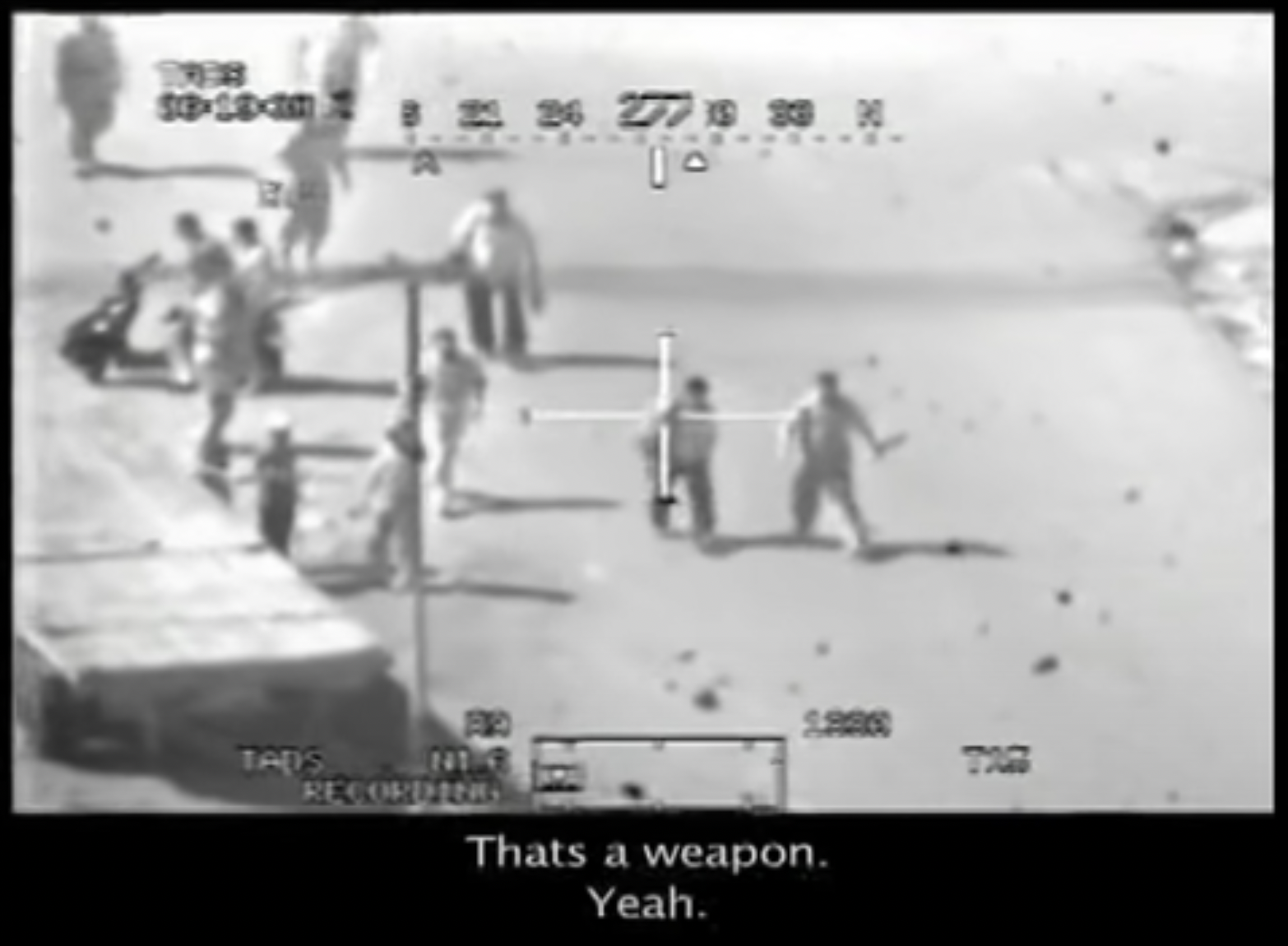
Negative peace and obnoxious silence could lead to extreme, unpredictable situations, when telling, exposing truth is an act of crime. “I had a responsibility to the public. I stopped seeing just statistics and information and I started seeing people.”🌏️ The words come from Chelsea Manning, a trans whistleblower during an ABC exclusive interview. Wikileaks released an edited video footage called Collateral Murder (fig1) with the help of Chelsea Manning. It was recorded in 2007 from a U.S. Apache helicopter attack in Baghdad, Iraq, killing at least nine men, including a Reuters news photographer and his driver.
“The story of Collateral Murder is about how the very exposure of a crime was itself defined a crime, and that we are told, with no hint of irony, that the real threat to democracy is the fact that we have access to these pictures or documents at all. With logic like that, there is little wonder that these forms of dissent are likely to continue.” 🌎️
The message of the video footage is a reminder that the very act of exposing a secret material that challenges state power can be as powerful as the material itself.